"When you lighten someone's load, you don't allow them to expand." This quote is from Invisibilia's "How to Become Batman" podcast. The main idea behind this episode is that our expectations affect others, and their expectations affect us. As a student-teacher, I took this as a reminder that I need to be cognizant of my own expectations. I need to take stock of my expectations, particularly my expectations for myself and my students. Jacob and Wilder (2010) highlight the importance of expectations in education: "Expectations have become somewhat less predictive of attainment over the
past several decades but expectations remain strong predictors of
attainment above and beyond other standard determinants of schooling."
If you're interested in further readings, you can check out this article about how teachers' expectations affect student learning. Finally, here is a video about student expectations that raises some important points in an engaging way:
I have been seeing a lot about "making thinking visible," and I am trying to do that with my own thinking. In Art Education, the instructor is emphasizing that showing process is both important and beautiful. In Education Technology, the term "selfie your learning" is being used to get at the same thing. Science Education is about the scientific process, particularly through inquiry. In Math Education, reasoning and showing your thinking are being emphasized. This is the growth mindset in action. How do you make thinking visible, and avoid being an intellectual black hole?
How do black holes work?
In the name of making thinking visible, I decided to use Storify to document my journey through my Science Education inquiry project: How do black holes work? It seems particularly fitting, since this video poses the question "How do you study something that by nature evades detection?" This Storify will be a work in progress for the next week, so I invite you to follow along, and if you have any resources, please let me know!
P.S. I love how Storify lets me curate across platforms!
On Monday, March 2nd, at 11:30am (PST) I will be facilitating the first #edci336chat. The topic will be tweetiquette and Twitter in education. I created the image above to advertise the chat. I used this image, which I found throuh CC Search, as my starting point. Yesterday evening I participated in the #BCEdChat about world events in the classroom. Through participating in Twitter chats, I have seen the following things that I would like to use for #edci336chat:
Today I tweeted to a few individuals who I have seen moderate on the #BCStuTeach and #BCEdChat Twitter chats to ask them for some tips. Do you have any tips on tweetiquette or moderating Twitter chats?
Yesterday morning I attended a Universal Design for Learning (UDL) workshop arranged by @UVicEdSA. I created this infographic about the workshop, and further details can be found within this post.
The workshop started with this video that explains UDL:
UDL is about facilitating multiple means of representation, engagement, and expression for learners.
The speaker shared these 3 things that specialists from her district would like student-teachers to consider:
Visuals,
Sensory needs (sensory tools, movement, environment), and
Clear, positive communication.
Visuals
These are some of the reasons visuals are important:
Provide consistent cues about students' daily activities and routines,
Reduce anxiety,
Help students with language processing difficulties,
Provide a permanent reminder, and
Build independence.
Many of us visuals every day. As I mentioned in a previous post, I use Google Keep and my Bullet Journal to keep myself organized. These are some classroom visuals that were suggested:
Visual schedule,
Checklists,
Volume meter,
Word wall, and
Time timer.
Some benefits of the time timer include:
Promotes ability to judge how much time is left,
Makes transitions smoother, and
Builds independence.
As with most strategies, it is best used as often as possible, and not just when a student 'needs' it.
We each have a unique "sensory diet" that dictates
what we need to make sure we're calm, alert, and ready to learn. I have
seen some educators tweeting this quote that expresses this:
The importance of movement breaks was emphasized, and we got to share and try out a bunch of strategies. Having movement breaks built in really helped me to keep focused and learning throughout the three-hour workshop! Here are some reasons why movement breaks are important:
They increase alertness and decrease anxiety,
Kids get stressed when they don't move enough,
Movement and sensory experience is necessary to strengthen connections between neurons,
Promote self-regulation, and
Help students stay on task.
Sensory tools:
Keep fingers and feet busy, minds focused, and bodies relaxed,
Work for some students some students and not for others,
Work on some days and not others,
Should be demonstrated and practiced.
Should be discussed as being tools, not toys.
Some examples of sensory tools include:
Fidget tools,
Stress ball,
Velcro strips,
Thinking putty,
Yarn sections,
Tension elastics on chairs,
Juggling balls,
Pencil grips,
Resistance bands, and
Foot rests.
Mindfulness
Mindfulness has become a very trendy topic in education lately. It is about paying attention to the present moment without judgement. The speaker said that it means "paying kind and curious attention to how you're feeling, and then making a kind choice."
Since the speaker wrote My Gratitude Jar, she read it to us, and I was able to buy a copy right after. It is a wonderful book, and I highly recommend it! I look forward to learning more about mindfulness, through the other books on this list. Check out the video below for an in-depth look at My Gratitude Jar:
Here are some gentle brain breaks that were suggested:
Take 5,
Hoberman sphere breathing,
Tone bar, and
Mindful eating (have students try paying special attention to their first bite of snack/lunch - how does it feel/taste?).
When doing breathing exercises, instead of saying "deep breaths" try "long, slow breaths". For those interested in learning more about this, Royal Roads University offers an Applied Mindfulness Meditation Certificate program.
Clear, Positive Communication
We were advised to reduce language and increase wait time. On average, we give children 1-2 seconds to respond to instructions. For all learners, it is important to chunk information (break it into smaller pieces) appropriately. Peter Johnson has written two books on empowering language: Choice Words and Opening Minds. Those books contain these phrases that could be used by teachers:
Yet,
We readers like too...,
I bet you're proud of yourself,
Thanks for coming today,
What if...?, and
That's not like you...
I started using "I bet you're proud of yourself" yesterday with my grade 1/2 Science Club students when they were coding on studio.code.org. One student answered: "I am! I didn't know how to code before, and now I am doing it!"
Sam Horn wrote Tongue Fu!, a book about verbal conflict. One take-away from this book is that replacing "but" with "and" allows for constructive feedback to be given without taking away the compliment.
Dianne Gossen's Restitution suggests these phrases:
What's your job now?,
What can I do to help you so you can...?, and
When will you be ready to start?
Carol Dweck's Growth Mindset implores educations to ask "I wonder how he or she will learn this..." rather than "I wonder if he or she will learn this..."
Visual Journal comparing my STEM Puns cartoons to mentor artist Natalie Dee
I have been having fun with my STEM Puns passion project. I created a visual journal entry comparing my cartoons to online cartoonist Natalie Dee. Through that process, I realized that I would like to try adding texture to my work.
Twitter Chats
On February 10th I took part in a #TwitterChatMarathon. I took part in an #EdChat about eliminating "us vs. them" dynamics in education, a #BCStuTeach chat about brain breaks, and a #TeacherFriends chat about diversity. As an added bonus, I won a resource prize from one of the #TeacherFriends moderators, @fuzzlady77.
Last night I participated in a #BCEdChat about social media in schools.
By participating in Twitter chats, I have grown my PLN significantly. I am now connected with experienced and pre-service teachers from a number of countries, including the United States and France.
Today I found out about Nurph, a Twitter chat platform, which might make this process easier. Currently I used Hootsuite.
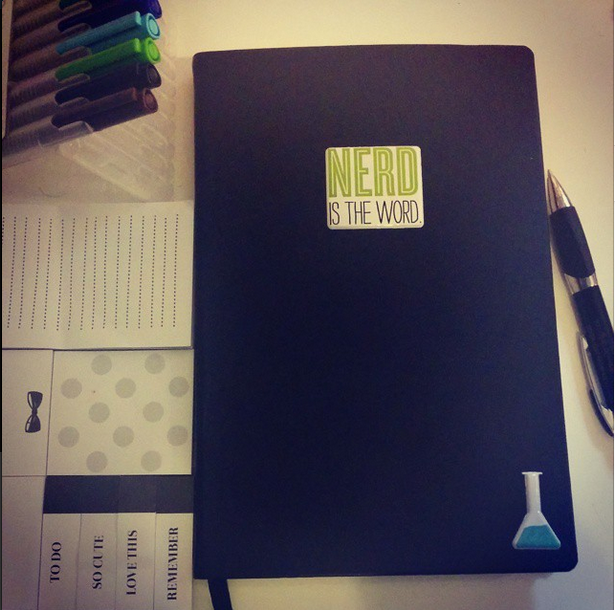
Last week I started the Bullet Journal system. I was finding myself avoiding my day-planner, because it had become an incoherent mess of post-its. Needless to say, that's not an ideal relationship to have with one's day planner. While I was en route to the Actua Conference, I saw an Instagram picture of someone's Bullet Journal. It piqued my interest, so I decided to look into it a little more. I looked at #bulletjournal on Instagram to see the work of some enthusiasts, watched this video which explains the process, and read some blog posts about it, both positive and negative. The latter (negative) blog post says that analog note-taking doesn't work. That may be
true for some people, but I think it's a deeply personal decision. Here are some reasons that I am drawn to the Bullet Journal system:
I am a list-maker and a post-it note fiend.
Since elementary school, I have relished trips to school and office supply stores.
Also, I love the aesthetic and feel of writing in a book.
The physical act of writing helps me to remember and feel calm.
My bullet journal will not lose charge, no matter how long my day is.
It helps me to capture the beauty of a work-in-progress.
I can quickly doodle or sketch ideas.
With a little bit of washi tape, I have an easy way to keep track of little bits of paper, like the odd receipt.
This system helps me to leave some ideas behind prioritize.
By no means am I opposed to digital reminders or task
management, but right now I am at a place in my life where I need a hard
copy of some things. Everyone needs to determine their own ideal process. In addition to my Bullet Journal, I use Google Keep
for quickly jotting down notes and reminders on my phone, because:
It's nice to be able to access these notes whenever I'm signed in to my
Google account,
The virtual post-its are easier to keep track of than a myriad of paper post-its, and
I can set an alarm for a reminder based on either time or location.
What does your personal organization system look like?
I visited my alma mater, Esquimalt High School, today. It was wonderful to see some of my
teachers (while some others are away on amazing adventures). I am proud
of my roots in EHS's community of learners/leaders, and our culture of
service and passion. Visiting as a student-teacher was a really amazing experience.
As I was leaving today, the word "nourish" was in my mind.I felt nourished - and not just because I ate lunch in the staff room. It was a more complete form of nourishment. Since alma means nourishing or kind in Latin, I am not the first to think this way about the nature of education!
Speaking of Latin, EHS's motto is Esse quam videri, which means "to be, rather than to seem." My teachers' authenticity has shaped who I am and how I live. They treated me as an equal, and encouraged me to go beyond what I thought I could do. They care so deeply for their students, for each other, and for the education profession. (Buzzwords and jargon aside: education relies on connection, like Rita Pierson says in her TEDTalk.) My goal is to honour them by striving to be the best teacher I can be.
Inquiry-based? Tech yeah!
Tech should not just be used for its own sake. This morning I visited @trev_mackenzie's English 12 class. It was awesome to witness an inquiry-based classroom culture being created. Technology was being integrated from the very start. Students had access to iPads to enhance classroom activities, and they are assigned blog posts as a way to keep track of their learning. Students in this class are also given the opportunity to use Explain Everything to create presentations. The classroom was equipped with an Apple TV, which was hooked up to an LCD projector. This arrangement is great showcasing student work and facilitating discussions.
Great writing comes from passion and strong, informed opinions. What does really good teaching look like? The students discussed this question to get them ready for their first blog posts. This is an important question to think about, so I created this infographic with their answers. I have long admired infographics, but this is my first time making one. I used infogr.am. I will definitely be making more infographics. I am going to look into other ways to create them. I love quick, accessible representations of information that are easily shared on social media!
RBCM Learning Portal
At EHS, I heard about the Royal BC Museum's new Learning Portal today. I took a brief look at it, but I think it will be the source of hours of a-museum-ent. Seriously though, there is some amazing content, and it looks like it's only going to get better!